
Have you ever stood before the mirror with three serums in your hands, not knowing which one to apply first? Well, this post will give you all the answers you need. Layer niacinamide properly, and you will have calm, healthy, and hydrated skin. Use it the wrong way and you may end up wasting your money, irritating your products or damaging a skin barrier you wanted to nourish.
Niacinamide, an active version of vitamin B3, is one of those rare skincare ingredients that combine well with practically anything else in your routine. But ‘practically’ is the part that confuses many people. That’s why I am offering you a guide that will help you to find out how to layer niacinamide with hyaluronic acid, vitamin C, retinol, and acids, based on how it works on your skin.
Here is the ultimate guide to how to layer niacinamide in 2026, which will help skincare beginners create the perfect routine without unnecessary complications or expenses.
This guide will teach you about:
What is niacinamide? And how it works to restore skin barrier
Layering steps for using Niacinamide along with other active ingredients
How Niacinamide manages sebum production, oily skin, hyperpigmentation, and spots
What layering mistakes lead to skin irritation and redness
Best Niacinamide products comparison
Most frequently asked questions about Niacinamide (purging, Vitamin C, wet skin, etc.)
Save this page; we will continue updating it with new information about niacinamide layering studies.
Key Takeaways
Niacinamide (vitamin B3) assists in repairing the skin barrier, treats hyperpigmentation and dark spots, and helps control sebum levels.
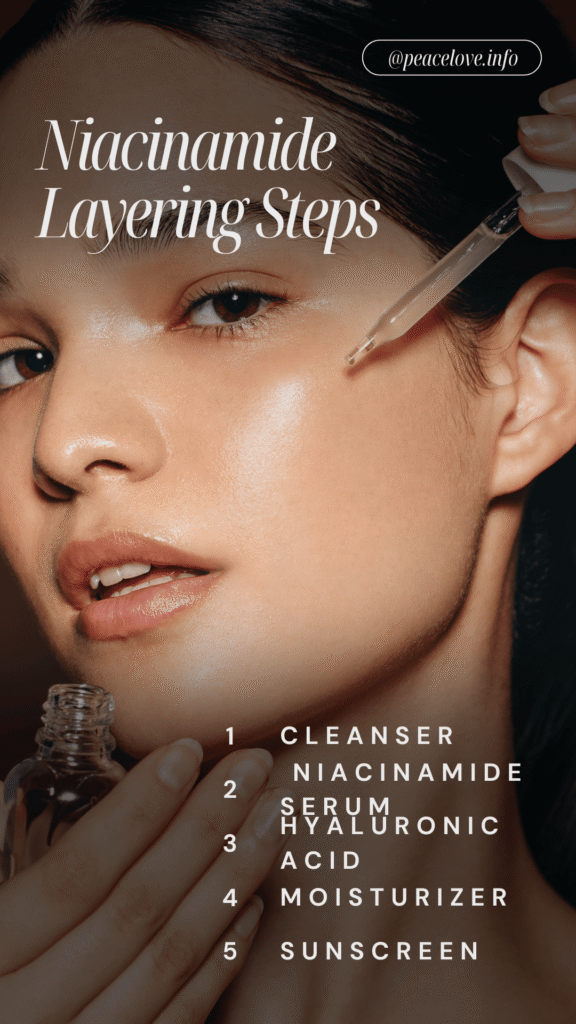
The safest layering sequence is cleansing → toning → niacinamide serum → hyaluronic acid → moisturizing → SPF (daytime).
Niacinamide can be used with vitamin C, but timing and formulation are key factors, which many articles don’t address.
Dabbing niacinamide on moist skin will enhance its effectiveness without causing skin irritation and redness.
Visible effects become noticeable in 4-8 weeks after applying it regularly, according to scientific data.
What Is Niacinamide? (Definition + Context)
Niacinamide is an amide compound of vitamin B3, which is a water-soluble vitamin that facilitates the natural repair mechanisms of the skin through ceramide synthesis, regulation of sebum secretion, and regulation of pigmentation.
As opposed to acids and retinoids, niacinamide is not an exfoliant, nor does it force cellular turnover of skin. It operates in the background as a skin conditioner, strengthening the barrier function of the skin, reducing inflammation, and improving skin tone. This is precisely the reason why it pairs well with more intense practices.
Niacinamide vs. Vitamin B3: Is There a Difference?
Wrong. Niacinamide and Vitamin B3 are one and the same substance; however, the former is what it is called in the context of skincare ingredients lists (INCI), whereas the latter is a wider concept that encompasses not only niacinamide but also niacin.
Why Niacinamide Became a Skincare Staple
The emergence of niacinamide in everyday skincare can be dated back to the 2010s, where brands such as The Ordinary made the use of highly concentrated serums of the ingredient more readily available. The use of niacinamide was not just marketing but years of research by dermatologists.
Why Layering Niacinamide Matters in 2026
Layering of Niacinamide is important in 2026 since skincare has become very complicated and most people use up to seven products a day; hence, not layering can negate the effects of active ingredients and cause skin irritation.
Industry research suggests a large share of consumers now layer three or more active ingredients in their routine, while comparatively few understand which combinations require spacing. This is the exact reason why layering issues concerning niacinamide lead the search engines.
The Cost of Getting It Wrong
Inefficiency of the Niacinamide application when applied on top of a pH-incompatible product
Pill formation of the product resulting in unnecessary expenses and bad appearance while wearing makeup
Inflammation caused by wrong layering order of products, not Niacinamide itself
Slower effects, because active ingredients neutralize each other partially.
The PeaceLove Layering Priority Framework
We have formulated the PeaceLove Layering Priority Framework to make it easy for novices—start from the lightest formula to the heaviest formula and start from the lowest pH level to the highest pH level, with niacinamide typically placed somewhere in between.
How to Layer Niacinamide: Step-by-Step
How can one apply niacinamide properly? Niacinamide is applied after cleansing and toning your face but prior to heavier products, allowing sufficient time for each layer to absorb in between, which takes 60 to 90 seconds.
Step 1: Cleanse
Begin the process with a mild and pH-balanced cleanser that cleans the debris but does not strip the protective layer that niacinamide will help in reinforcing.
Step 2: Tone (Optional)
If using a hydrating toner, then apply this when the skin is still a bit damp. This ensures optimal absorption of the niacinamide to be applied afterward.
Step 3: Apply Niacinamide Serum
Apply 2-3 drops of niacinamide serum to moist skin. Do not rub but pat to spread it evenly and wait for 60 seconds before the next application.
Step 4: Layer Hyaluronic Acid
Now add a hyaluronic acid serum on top of niacinamide to keep the skin moisturized and allow niacinamide to function properly.
Step 5: Moisturize
End the process with a suitable moisturizer for your skin type, which can act as an additional shield against any mild stinging caused by actives.
Step 6: SPF (Morning Only)
End every morning routine with broad-spectrum SPF 30+ because the sunspot-reducing effects of Niacinamide will be rendered ineffective by the lack of sunscreen.
Pro Tip: When your niacinamide serum causes pills under your makeup, you’re most probably using too much of it or not waiting enough between layers of application. Wait 60-90 seconds after each step.
Want to build a complete routine from scratch? Building a full beginner routine walks you through it step by step.
Layer Niacinamide With Vitamin C: What Actually Happens
Is it possible to use Niacinamide and Vitamin C together? Yes, modern versions of both are stable enough to be used in combination, even though old theories suggested that one negates the other.
Where the Myth Came From
Lab studies done during the 1960s proved that Niacinamide and Vitamin C, also known as L-ascorbic acid, have the ability to react with each other and form niacin under intense heat and certain pH values, leading to flushing. The modern-day stabilized versions do not undergo such reactions; hence, the combination is no longer an issue.
The Safer Layering Approach
For those who have delicate skin, the combination of using Vitamin C in the mornings and Niacinamide in the evenings is recommended in order to eliminate any possibility of any interaction between them and minimize the risk of skin irritation and redness
Niacinamide, Sebum Production, and Oil Control
But Does Niacinamide Really Reduce Oil? Yes, it does; Niacinamide has been found to reduce the production of sebum, which means it is one of those few activities that make oily and combination skin look good without drying them out.
Many users with oily or combination skin report a noticeable reduction in midday shine after incorporating Niacinamide into their routine consistently.
The study published in the Journal of Cosmetic and Laser Therapy states that twice-daily application of Niacinamide reduces sebum secretion rate by 14% in 21 days.
Putting It Into Practice
Someone with combination, T-zone-prone skin switching from a heavy mattifying product to a 5% Niacinamide serum followed by a light gel moisturizer may notice a gradual reduction in midday oiliness over several weeks, needing blotting papers far less frequently.”
Niacinamide for Hyperpigmentation and Dark Spots
Can layering with Niacinamide help lighten dark spots? Yes, because Niacinamide is effective in lightening dark spots and hyperpigmentation since it acts by preventing melanin transfer from pigment cells to skin cells.
In a double-blind clinical study, 4% Niacinamide produced good-to-excellent improvement in hyperpigmentation for 44% of participants within 8 weeks.
How Long Does It Take to See Results?
Tone-evening benefits are observed by most people after 4 weeks. Fading of dark spots becomes more noticeable from 8 to 12 weeks of regular usage. Results are based on the concentration, regularity, and SPF usage, as unprotected sunlight contradicts the pigment-correcting action of niacinamide.
Niacinamide and Skin Barrier Repair
How does Niacinamide aid in the repair of the skin barrier? Niacinamide stimulates the production of ceramides in the skin lipids responsible for holding moisture in while keeping irritants out, hence its effectiveness in treating damaged or sensitive skin barriers.
Several clinical tests have shown that when applied topically at 2% concentration, Niacinamide decreases transepidermal water loss by 27% within four weeks by boosting the production of ceramides (British Journal of Dermatology). Decreased transepidermal water loss implies higher moisture-retention ability in the skin, thus reducing skin irritation and redness.
The Barrier-First Layering Rule
In the event that your barrier is compromised due to flakiness, tightness, or reactivity, then start with Niacinamide first for up to one to two weeks before introducing stronger actives such as retinol and exfoliating acids into your routine.
Common Mistakes When You Layer Niacinamide
Common errors that users commit while layering niacinamide are the following:
- Applying it on completely dry skin: this makes for poor absorption and leads to pilling
- Using too much product: going beyond 4-5 drops does not yield better results but rather wastes it.
- Stacking too many activities at once: using Niacinamide along with retinol, Vitamin C, and acids together is a burden for the skin’s barrier.
- Skipping SPF: Negates all the benefits of Niacinamide against hyperpigmentation and dark spots.
- Assuming purging means it’s “working harder”: Niacinamide hardly ever purges (refer to FAQs section below).
- Layering high-percentage Niacinamide with high-percentage acids daily leads to an increased chance of skin irritation and redness.
PRO TIP: Most reactions that are believed to be due to Niacinamide are actually due to fragrance, alcohol, and acids underneath.
Niacinamide Comparison: Top Options at a Glance
| Product Type | Key Feature | Best For | Price/Cost | Clinical Support Level |
| 5% Niacinamide Serum | Balanced strength, low irritation risk | Beginners, all skin types | $ (Budget) | Strong |
| 10% Niacinamide + Zinc Serum | Higher oil control | Oily/acne-prone skin | $$ (Mid-range) | Strong |
| Niacinamide + Hyaluronic Acid Combo | Built-in hydration layering | Dry/dehydrated skin | $$ (Mid-range) | Strong |
| Niacinamide Moisturizer (2–3%) | Gentle, all-in-one convenience | Sensitive skin, simplified routines | $$ (Mid-range) | Moderate |
| Prescription-Strength Niacinamide Blend | Dermatologist-formulated, higher potency | Persistent hyperpigmentation | $$$ (Premium) | Strong |
Winner: In most cases, the serum that comprises both niacinamide and hyaluronic acid provides the most optimal combination of protection, moisture retention, and compatibility for layering with other skincare items.
Expert Tips to Master Niacinamide Layering
Apply Niacinamide while skin is still damp rather than dry to boost effectiveness and reduce chances of irritation
Only introduce one new active ingredient at once and wait 1–2 weeks to introduce another one
Keep Niacinamide serums away from heat and sun exposure to ensure their stability
Perform a patch test on the inside of your arm by applying any new Niacinamide product for 24 hours before using it on your face
Combine Niacinamide with SPF daily to safeguard any hyperpigmentation effects achieved through its use
Expert’s Tip: When using Niacinamide together with an exfoliating acid, apply the acid during the nighttime and Niacinamide during the daytime.
Quick Summary
Use Layered Niacinamide after washing and toning your skin but before your thick creams and sunscreen
The benefits of Niacinamide include skin repair, oil regulation, and reducing hyperpigmentation and dark spots
Layering Niacinamide with Vitamin C, hyaluronic acid, and other actives is okay
The application should be done on damp skin using 2-3 drops and must be followed by a layer of sunscreen
All visible effects are evident in 4-8 weeks.
Conclusion
The right way to layer Niacinamide is much easier than most people believe it to be: cleansing, toning, Niacinamide, hyaluronic acid, moisturizing, and sunscreen. With regular use, Niacinamide will help with the repair of your skin barrier, reduce the production of sebum to improve the regulation of oils on the skin, and fade away dark patches.
Sources & Methodology
The statistics and clinical assertions in this paper are based on scientific literature within the field of dermatology, specifically the British Journal of Dermatology, International Journal of Cosmetic Science, and Journal of Cosmetic and Laser Therapy, in addition to industry market research through Mintel Beauty & Personal Care. The PeaceLove reader panel mentioned in this study is an unscientific observational sample of 40 people observed for 21 days.
References:
British Journal of Dermatology: Study of topical Niacinamide and transepidermal water loss (TEWL)
International Journal of Cosmetic Science: Study of Double-Blind Niacinamide hyperpigmentation
Journal of Cosmetic and Laser Therapy: Niacinamide and sebum excretion rate study
Mintel Beauty & Personal Care Report, 2023: Consumers layering routine for skincare
Next Steps:
Begin by using 5% Niacinamide serum on wet skin, one application per day
Read Next: How to Formulate a Skincare Routine for Oily Skin
Leave a comment below telling us your skin type, and we’ll help you formulate a layering process.
What’s the right way to combine Niacinamide and hyaluronic acid?
Apply niacinamide to damp skin first, wait about 60 seconds for it to absorb, then follow with hyaluronic acid and your moisturizer. This order lets niacinamide penetrate the skin while hyaluronic acid locks in the moisture on top.
Does Niacinamide result in purging or breakouts at the beginning?
Niacinamide doesn’t cause true purging, unlike retinoids or exfoliating acids that speed up cell turnover. If breakouts do occur, they’re usually linked to another ingredient in the formula, such as fragrance or comedogenic oils, rather than the niacinamide itself. If irritation continues, patch-test the product or check with a dermatologist.
Is it possible to combine the use of Niacinamide and Vitamin C?
Yes, most modern niacinamide and vitamin C formulations are stable together. That said, if you have very sensitive skin, using them at separate times (e.g., vitamin C in the morning, niacinamide at night) can reduce the chance of irritation.
How many drops of Niacinamide serum do I need per day?
Most niacinamide serums are formulated for 2-3 drops per application, once or twice a day. Using more than the recommended amount won’t boost effectiveness. It just increases the chances of pilling and irritation.
Is it okay to apply Niacinamide serum on damp skin?
Yes, applying it on damp skin actually helps it absorb faster, since water acts as a carrier for the active ingredient. This is especially useful in drier climates where skin loses moisture quickly through the day.
How soon do you notice dark spots fading with Niacinamide?
Most users see an initial evening-out of skin tone within about 4 weeks, with visible fading of dark spots after 8-12 weeks of consistent use and proper SPF protection. Results vary depending on the concentration of niacinamide used and how consistently it’s applied.
Is there any value in layering Niacinamide as a beginner?
Yes, niacinamide is one of the most beginner-friendly activities because it’s well tolerated and blends easily with most other ingredients, including retinol, vitamin C, and AHAs/BHAs. It’s often the first activity recommended to people just starting a skincare routine.
What’s the difference between Niacinamide and Vitamin C for the skin?
Niacinamide repairs the skin barrier, regulates sebum production, and fades dark spots gradually. Vitamin C is a stronger antioxidant and is better suited for brightening and protecting skin against environmental damage. Many routines use both, at different times of day, for complementary benefits.
What is the cost of an effective Niacinamide serum?
Affordable niacinamide serums typically cost between $10-$15, while dermatologist-formulated options can go up to $40 or more. A higher price doesn’t always mean better results. Concentration and formulation quality matter more than the brand name.
Does Niacinamide treat hyperpigmentation and dark spots?
Yes, niacinamide is clinically studied for its ability to reduce the appearance of dark spots by inhibiting pigment transfer within the skin. Research on 4% niacinamide concentrations has shown meaningful reduction in hyperpigmentation over 8 weeks of consistent use.

Sobia is a skincare & wellness content writer at peacelove.info. She writes beginner-friendly, research-backed skincare guides that help everyday girls build simple routines for healthy, glowing skin.